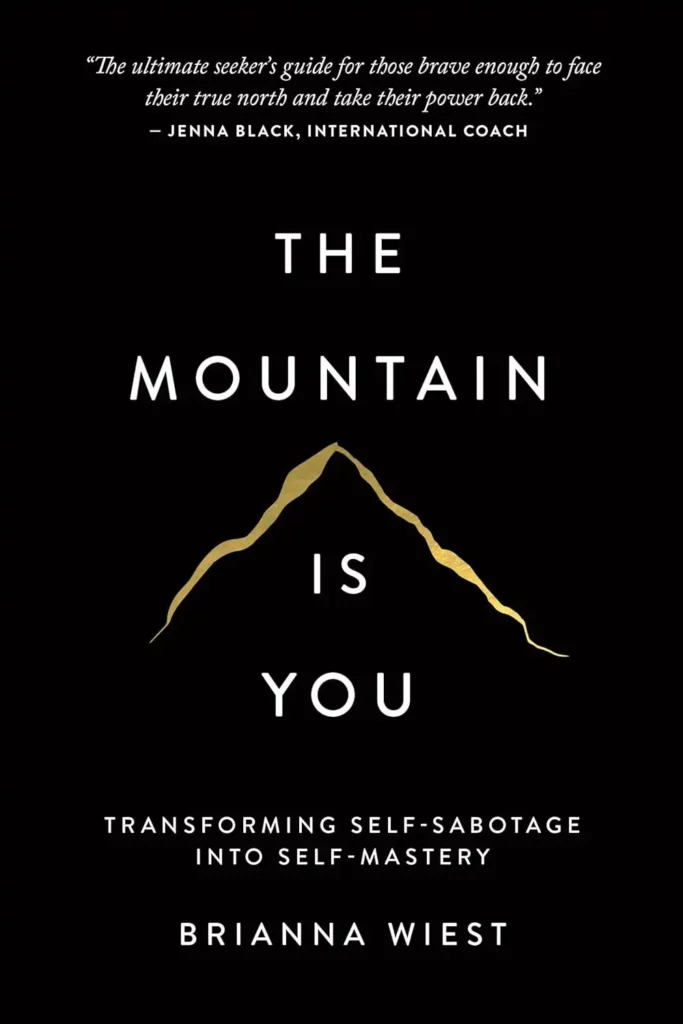
Boost your emotional intelligence with Brianna Wiest’s ‘The Mountain Is You’: Learn to understand emotions as thought reflections, overcome self-sabotage, and use a 3-step processing framework—get clear, validate, course correct—plus meditation, body awareness, and daily practices for healthier relationships and decisions.
You can have a genius-level IQ and still sabotage your relationships, career, and happiness. The missing piece isn’t more knowledge or better reasoning—it’s emotional intelligence, the ability to understand, interpret, and respond to your emotions in ways that serve rather than sabotage you.
In “The Mountain Is You,” Brianna Wiest argues that self-sabotage is fundamentally a product of low emotional intelligence. When you don’t understand what your emotions are telling you, when you can’t process feelings effectively, when you mistake every strong sensation for truth—you get stuck. Building emotional intelligence isn’t about suppressing or controlling emotions. It’s about developing a sophisticated relationship with your internal experience.
What Emotional Intelligence Actually Means
Emotional intelligence (EI) is often misunderstood as being nice, agreeable, or emotionally expressive. In reality, it’s something far more nuanced and powerful. Wiest defines it as “the ability to understand, interpret, and respond to your emotions in an enlightened and healthy way.”
High emotional intelligence means you can identify what you’re feeling, understand what triggered it, and choose how to respond rather than simply reacting. It means you can sit with discomfort without either suppressing it or being consumed by it. It means you can separate what you feel from what is objectively true.
This skill set isn’t innate—it’s learned. And the fact that most people were never taught it explains why so many intelligent, capable individuals struggle with anxiety, relationships, and self-defeating patterns. They never learned the language of emotions, so they’re trying to navigate their inner world without a map.
Your Emotions Are Information, Not Commands
One of the fundamental shifts in building emotional intelligence is understanding that emotions are data points, not directives. Wiest emphasizes that “your feelings are not always reflective of reality. They are, however, always accurate reflections of our thoughts.”
This distinction is crucial. Feeling anxious doesn’t mean something bad is about to happen—it means your thoughts are focused on potential threats. Feeling unworthy doesn’t mean you lack value—it means you’re thinking thoughts that reinforce unworthiness. Feeling angry doesn’t mean someone wronged you—it means something violated your expectations or boundaries.
When you treat emotions as absolute truth, you become their prisoner. When you understand them as responses to thoughts (which may or may not be accurate), you gain agency. You can investigate: What thought triggered this feeling? Is that thought based in current reality or past programming? What does this emotion want me to know?
The Most Misunderstood Emotions
Wiest dedicates significant attention to helping readers understand what different emotions actually communicate. This knowledge is essential for building emotional intelligence, because you can’t respond appropriately to a signal you’ve misinterpreted.
Anger, she explains, isn’t just destructive aggression. “Anger is a beautiful, transformative emotion. It is mis-characterized by its shadow side, aggression, and therefore we try to resist it.” Anger shows you where your boundaries are and what you find unjust. It’s trying to mobilize you, to initiate action. When you suppress it, it festers into resentment or explodes inappropriately. When you understand it, it becomes fuel for necessary change.
Sadness is the normal response to loss. “Sadness only becomes problematic when we do not allow ourselves to go through the natural phases of grief.” Emotional intelligence means recognizing that sadness needs expression, not elimination. You can’t think yourself out of grief—you have to feel your way through it.
Jealousy reveals what you want but aren’t allowing yourself to pursue. “When we see someone who has something we really want but we are suppressing our willingness to pursue it, we must also condemn it in them so we can justify our own course of action,” Wiest notes. Jealousy isn’t proof that someone else has stolen your opportunities—it’s showing you what you’re capable of creating for yourself.
Guilt often reflects programming from childhood about being a burden or being wrong. Unless you’ve actually harmed someone, guilt is usually your internalized voice of someone who made you feel like you were too much or not enough. Understanding this allows you to separate appropriate remorse from inappropriate self-punishment.

Building the Skill of Emotional Processing
Knowing what emotions mean intellectually is different from being able to process them in real time. Wiest offers a practical framework for healthy emotional processing:
First, get clear on what happened. Not your interpretation, not the story you’re telling yourself—what objectively occurred. “I didn’t get the promotion” is different from “I’m a failure who will never succeed.” The first is a fact; the second is an interpretation loaded with emotion.
Second, validate your feelings. “Recognize that you are not alone; anyone in your situation would probably feel similarly (and does) and that what you feel is absolutely okay.” This doesn’t mean your feelings are necessarily accurate—it means they’re valid responses to your current thoughts and circumstances.
Third, determine a course correction. Once you’ve felt the emotion and understood its message, what action (if any) does it suggest? Anger about injustice might lead to advocacy. Sadness about a loss might lead to grief rituals. Anxiety about an upcoming event might lead to preparation.
This three-step process prevents two common errors: suppressing emotions entirely (which backfires) and wallowing in them endlessly (which becomes self-indulgent). You acknowledge, you feel, you respond—then you move forward.
The Difference Between Controlling and Suppressing
Building emotional intelligence requires understanding a crucial distinction: controlling your emotions versus suppressing them. Wiest clarifies: “Suppressing is unconscious; controlling is conscious.”
When you suppress emotions, you’re not aware of them. They’re operating beneath consciousness, influencing your behavior in ways you don’t recognize. You snap at your partner without realizing you’re actually angry about work. You avoid social situations without connecting it to underlying anxiety. The emotion is still affecting you—you just can’t see it.
When you control your emotions, you’re fully aware of what you’re feeling, but you’re choosing how to respond. You’re angry at your partner but you choose to take a breath before speaking. You’re anxious about the presentation but you choose to prepare rather than avoid. You feel the emotion fully—you just don’t let it dictate your behavior.
“When you’re controlling your emotions, you do know how you feel, and your behavior seems within your control,” Wiest explains. This is the hallmark of emotional intelligence: awareness plus choice.
Your Brain’s Design and Emotional Intelligence
Understanding how your brain processes emotion is essential for developing emotional intelligence. Wiest explains that your brain wasn’t designed for happiness—it was designed for survival. “Your brain is built to reinforce and regulate your life. Your subconscious mind has something called a homeostatic impulse, which regulates functions like body temperature, heartbeat, and breathing.”
This same system tries to regulate your mental and emotional state, which is why change—even positive change—can feel threatening. Your brain interprets unfamiliar as potentially dangerous, regardless of whether the unfamiliarity is actually harmful.
This means your emotions aren’t always giving you accurate information about current reality. They’re often just your brain trying to return you to what’s familiar. Understanding this prevents you from blindly trusting every feeling as prophetic wisdom.
Wiest notes that “your feelings aren’t predictions. They are not fortune-telling mechanisms. They are only reflecting back to you what your current state of mind is.” When you feel dread about an upcoming event, that’s not a premonition—it’s just your anxiety speaking. Learning to distinguish between instinct and anxiety is a cornerstone of emotional intelligence.
Developing the Skill of Self-Observation
Emotional intelligence requires you to develop a relationship with yourself where you can observe your thoughts and feelings without being consumed by them. Wiest describes meditation not as a practice of forcing calmness, but as training in observation: “The point of meditation is to sit idly as you experience all of those feelings come up: the rage, the fear, the sadness, the overwhelming mind chatter…and in spite of how alluring or triggering it may be, you learn to stay still and not respond to it.”
This practice creates space between stimulus and response. When someone criticizes you, instead of immediately defending yourself or collapsing into shame, you can observe: “I’m having a strong reaction. My chest is tight. I’m thinking thoughts about being inadequate. Interesting.” This observation doesn’t eliminate the emotion—it prevents it from hijacking your behavior.
Over time, this practice reveals that thoughts and feelings are temporary events, not permanent truths. The anger that felt overwhelming passes. The anxiety that seemed unbearable subsides. You begin to trust yourself to weather emotional storms because you’ve watched yourself do it repeatedly.
The Role of Physical Sensations
Emotional intelligence isn’t purely mental—it requires attention to physical sensations. Wiest emphasizes that “emotions are physical experiences” that create “a motor component, which means that the minute they begin—before you can suppress or ignore them—they create a micro-muscular activation.”
This is why you might feel anxiety in your stomach, heartache in your chest, or stress in your shoulders. The emotions aren’t just abstract feelings—they’re embodied experiences trying to complete a physical cycle.
Building emotional intelligence means developing body awareness. When you notice tension in your jaw, you can pause and ask: “What am I clenching against? What am I resisting?” When you feel heaviness in your chest, you can investigate: “What sadness am I carrying?” The body often knows before the mind catches up.
Wiest recommends breath scans as a practice: “Breathe in and out slowly, without taking a break between breaths. When you do this, you will begin to notice that you might hit a ‘snag’ or hiccup somewhere, that in the process of taking your breath, you will start to feel precisely where in your body you are storing tension.”
The Relationship Between Thoughts and Feelings
One of the most important aspects of emotional intelligence is understanding the relationship between thoughts and feelings. Wiest explains: “Our feelings are not intended to guide us throughout life; that is what our mind is for. If you were to honestly follow your every impulse, you would be completely stuck, complacent, and possibly dead or at the very least in severe trouble.”
This challenges popular wisdom that suggests you should always follow your feelings. Your feelings are responses to your thoughts, which may be based on outdated programming, cognitive biases, or misinterpretations. Following them blindly leads to chaos.
Instead, emotional intelligence means using your thoughts to examine your feelings: “Why am I feeling this way? What thought triggered this emotion? Is that thought accurate? What would a more accurate thought be?” You’re not dismissing the feeling—you’re investigating its source so you can respond appropriately.
Building Emotional Intelligence in Relationships
Emotional intelligence transforms relationships because it allows you to distinguish between your reactions and others’ actions. Wiest notes that a common sign of low emotional intelligence is “ascribing intent or worrying that things are about you when they aren’t.”
High emotional intelligence means recognizing that other people’s behavior is usually about them, not you. When someone is short with you, instead of immediately assuming you did something wrong, you can consider: “Maybe they’re having a hard day. Maybe this has nothing to do with me.” This doesn’t mean you ignore genuine mistreatment—it means you don’t automatically personalize neutral events.
It also means taking responsibility for your own emotional experience rather than blaming others for how you feel. “You made me angry” becomes “I felt angry when you did that.” This subtle shift acknowledges that your emotional response is yours, even if someone else’s behavior triggered it.
The Practice of Emotional Intelligence
Building emotional intelligence is a daily practice, not a one-time achievement. Wiest emphasizes that “mental health and self-mastery is the ability to see and feel and experience a thought without responding to it.”
This practice involves:
- Noticing emotions as they arise
- Identifying the thought that triggered them
- Assessing whether that thought is accurate
- Choosing how to respond (or not respond)
- Allowing the emotion to move through without suppression or dramatization
Over time, this becomes more automatic. You develop what psychologists call “emotional granularity”—the ability to distinguish between subtle variations of emotion and respond with precision rather than broad reactivity.
The payoff is profound: relationships improve because you’re not constantly reacting to perceived slights. Decision-making improves because you’re not swayed by temporary emotional states. Self-sabotage decreases because you understand the emotional needs your destructive behaviors were trying to meet—and you find healthier ways to meet them.
As Wiest concludes: “Emotional intelligence is the ability to understand, interpret, and respond to your emotions in an enlightened and healthy way. People with high emotional intelligence are often able to better get along with different types of people, feel more contentment and satisfaction in their everyday lives, and consistently take time to process and express their authentic feelings.”
Building this capacity isn’t easy, but it’s possible for anyone willing to do the work. It requires patience with yourself as you learn a new language—the language of your own internal experience. But mastering this language is perhaps the most valuable skill you can develop, because it transforms every aspect of how you move through the world.