
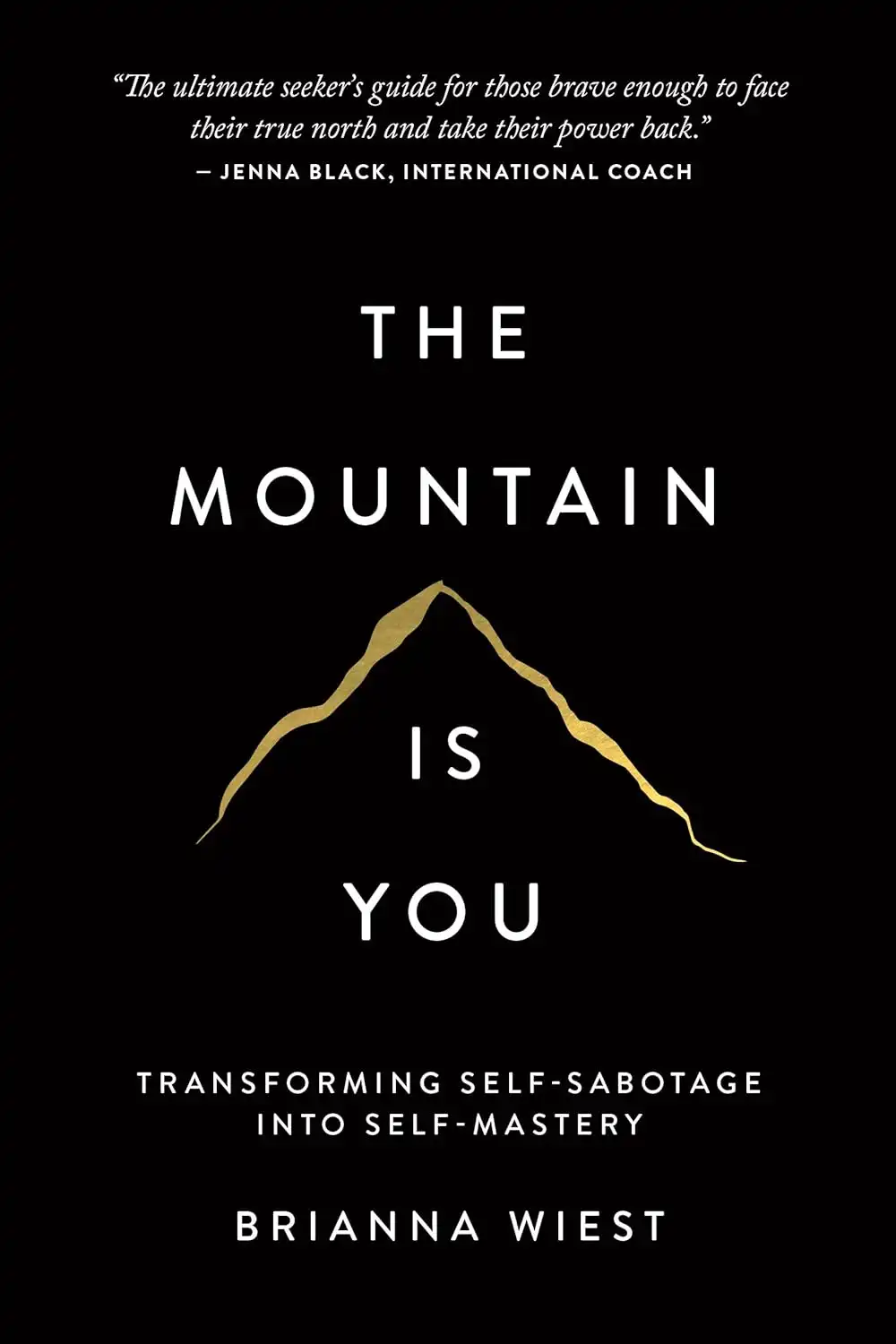
If you’ve picked up Brianna Wiest’s “The Mountain Is You” or are considering reading it, you’re likely dealing with a familiar frustration: knowing what you need to do but somehow being unable to do it. You understand your patterns are self-destructive, yet you keep repeating them. You want to change, but something invisible holds you back.
Wiest’s book has resonated with millions because it doesn’t offer superficial solutions or motivational platitudes. Instead, it provides a psychological framework for understanding why intelligent, capable people remain stuck—and how to genuinely move forward. The central thesis is both challenging and liberating: the mountain blocking your path isn’t an external obstacle. It’s you. More specifically, it’s the unconscious patterns, unprocessed emotions, and conflicting needs within you that create the life you’re living.
This comprehensive summary captures the 25 most transformative insights from the book, each supported by Wiest’s own words. Whether you’re reading this before diving into the full text or as a refresher after completing it, these concepts form the foundation of her approach to moving from self-sabotage to self-mastery.
1. Self-Sabotage Is Protection, Not Punishment
The Insight: Your self-destructive patterns aren’t evidence that you hate yourself or lack discipline. They’re your psyche’s misguided attempt to keep you safe from perceived threats like vulnerability, failure, or change.
The Quote: “Self-sabotage is not a way we hurt ourselves; it’s a way we try to protect ourselves.”
This reframe changes everything. When you understand that your behaviors serve a protective function—however maladaptive—you can stop fighting yourself and start understanding what you’re trying to protect yourself from. The procrastination, the relationship sabotage, the health neglect—these aren’t signs of weakness. They’re symptoms pointing toward unmet needs and unresolved fears.
2. Your Mountain Is Your Internal Conflict
The Insight: The obstacles in your life aren’t random external forces. They’re the manifestation of conflicting needs within you—the collision between what you consciously want and what you unconsciously fear or require.
The Quote: “Just as a mountain is formed when two sections of the ground are forced against one another, your mountain will arise out of coexisting but conflicting needs. Your mountain requires you to reconcile two parts of you: the conscious and the unconscious, the part of you that is aware of what you want and the part of you that is not aware of why you are still holding yourself back.”
Understanding this helps you stop blaming circumstances and start examining the internal contradictions creating your stuck points. You might want success but fear visibility. You might desire intimacy but avoid vulnerability. These opposing forces create the mountain you must climb.
3. Big Problems Are Actually Big Attachments
The Insight: When solutions seem obvious yet impossible to implement, you don’t have a problem with the situation—you have an attachment to it because it’s serving an unconscious function.
The Quote: “When you have big, ongoing, insurmountable issues in your life—especially when the solutions seem so simple, so easy, and yet so impossible to stick with—what you have are not big problems but big attachments.”
This explains why someone might stay in a draining job, toxic relationship, or unhealthy habit despite knowing better. The behavior is meeting a need—perhaps for familiarity, identity, or protection from something scarier. Until you identify and address that need, willpower alone won’t create lasting change.
4. Your Feelings Aren’t Facts
The Insight: Emotions provide valuable information about your thoughts and internal state, but they’re not objective truth or accurate predictions about reality or the future.
The Quote: “Though your emotions are always valid and need to be validated, they are hardly ever an accurate measure of what you are capable of in life. They are not always an accurate reflection of reality. All your feelings know is what you’ve done in the past, and they are attached to what they’ve drawn comfort from.”
This distinction is crucial for decision-making. You can acknowledge feeling like a failure without concluding you are one. You can notice fear without treating it as prophetic warning. Emotions are responses to thoughts, which may or may not be accurate.
5. The Breakdown Precedes the Breakthrough
The Insight: What feels like rock bottom is often the tipping point before transformation. Crisis forces the confrontation with self that comfort allows you to avoid.
The Quote: “The breakdown is often just the tipping point that precedes the breakthrough, the moment a star implodes before it becomes a supernova.”
People don’t usually change because inspiration strikes. They change when staying the same becomes more painful than the discomfort of transformation. The darkest moments often precede the greatest growth—not because suffering is noble, but because it strips away denial and forces honest reckoning with what needs to shift.
6. Emotional Intelligence Is the Foundation
The Insight: Most self-sabotage stems from low emotional intelligence—the inability to identify, understand, and appropriately respond to your emotions.
The Quote: “Self-sabotage is ultimately just a product of low emotional intelligence. To move on with our lives in a healthy, productive, and stable way, we need to understand how our brains and bodies work together. We need to understand how to interpret feelings, what different emotions mean, and what to do when we are faced with big, daunting sensations that we don’t know how to handle.”
When you can’t process emotions effectively, they control you. You suppress them until they explode, or you’re consumed by them, or you mistake their intensity for truth. Developing emotional intelligence—learning to feel without being overtaken, to understand what emotions communicate, to respond rather than react—is foundational to all other growth.
7. Anger Shows You Your Boundaries
The Insight: Anger isn’t just destructive emotion to be suppressed. It’s information about where your boundaries are and what you find unjust, and it mobilizes you toward necessary action.
The Quote: “Anger is a beautiful, transformative emotion. It is mis-characterized by its shadow side, aggression, and therefore we try to resist it. It is healthy to be angry, and anger can also show us important aspects of who we are and what we care about. For example, anger shows us where our boundaries are. Anger also helps us identify what we find to be unjust. Ultimately, anger is trying to mobilize us, to initiate action.”
When you understand anger’s function, you can use it constructively rather than suppressing it (which leads to resentment) or expressing it destructively (which damages relationships). Anger is fuel for change when properly channeled.
8. Your Upper Limit Keeps You Stuck
The Insight: You have a tolerance threshold for happiness and success. When you exceed it, you unconsciously sabotage to return to familiar emotional territory, even if that territory is less pleasant.
The Quote: “There is only a certain amount of happiness that most of us will allow ourselves to feel. It is your tolerance and threshold for having positive feelings or experiencing positive events. When you begin to surpass your upper limit, you start to unconsciously sabotage what’s happening in order to bring yourself back to what’s comfortable and familiar.”
This explains why success can trigger anxiety, why good things make you nervous, and why you might ruin relationships when they’re going well. Your nervous system hasn’t adjusted to the new level of goodness, so it feels threatening until it becomes familiar.
9. Familiarity Feels Safer Than Better
The Insight: Your brain prioritizes the familiar over the beneficial because from an evolutionary perspective, familiar equals safe and unknown equals potential threat—regardless of whether the familiar situation is actually good for you.
The Quote: “Human beings experience a natural resistance to the unknown, because it is essentially the ultimate loss of control. This is true even if what’s ‘unknown’ is benevolent or even beneficial to us. Self-sabotage is very often the simple product of unfamiliarity, and it is because anything that is foreign, no matter how good, will feel uncomfortable until it is also familiar.”
This is why you might stay in situations that clearly don’t serve you and why positive change triggers discomfort. You’re not broken—you’re operating according to a nervous system designed for survival, not happiness. Overcoming this requires gradually expanding your comfort zone.
10. Rock Bottom Is Often a Turning Point
The Insight: The moment you hit rock bottom can become transformative not because of the pain itself, but because it forces a crucial decision: never again.
The Quote: “Rock bottom becomes a turning point because it is only at that point that most people think: I never want to feel this way again. That thought is not just an idea. It is a declaration and a resolution. It is one of the most life-changing things you can ever experience. It becomes the foundation upon which you build everything else.”
This isn’t romanticizing suffering—it’s recognizing that sometimes the situation must become unbearable before you commit fully to change. The declaration “never again” becomes the foundation for genuine transformation when you mean it completely.
11. Your New Life Will Cost Your Old One
The Insight: Genuine change requires letting go of relationships, identities, and comfort zones that defined your old life. This isn’t failure—it’s evolution.
The Quote: “Your new life is going to cost you your old one. It’s going to cost you your comfort zone and your sense of direction. It’s going to cost you relationships and friends. It’s going to cost you being liked and understood. It doesn’t matter. The people who are meant for you are going to meet you on the other side.”
Growth requires death—the death of who you were, what you knew, and who you surrounded yourself with. This isn’t tragic; it’s necessary. The person you’re becoming can’t be built on the foundation of who you were.
12. Triggers Are Guides, Not Problems
The Insight: The things that trigger intense emotional reactions aren’t obstacles—they’re signposts pointing toward wounds that need healing or growth that needs to happen.
The Quote: “Triggers are not random; they are showing you where you are either most wounded or primed for growth. If we can see these triggers as signals that are trying to help us put our attention toward some part of our lives that needs healing, health, and progress, we can begin to see them as helpful instead of hurtful.”
Instead of avoiding triggers, you can use them as information. What specifically triggered you? What does that reveal about unhealed wounds or areas requiring growth? This transforms triggers from things to fear into valuable feedback.
13. Microshifts Create Transformation
The Insight: Lasting change doesn’t come from dramatic breakthroughs or massive overhauls. It comes from tiny, consistent shifts that compound over time.
The Quote: “A mind-blowing, singular breakthrough is not what changes your life. A microshift is. Breakthroughs are what happen after hours, days, and years of the same mundane, monotonous work. If you want to change your life, you need to make tiny, nearly undetectable decisions every hour of every day until those choices are habituated.”
This is simultaneously humbling and empowering. You don’t need to transform overnight—you need to make one small choice today, then another tomorrow. Over time, these microshifts create fundamental change that dramatic gestures never achieve.
14. Worrying Is the Weakest Defense System
The Insight: Chronic worry masquerades as preparation but actually weakens you by keeping your nervous system in constant alarm mode without solving anything.
The Quote: “Rumination is the birthplace of creativity. They’re controlled by the same part of the brain. That’s the neurological reason there’s a stereotype about ‘depressed creatives.’ Any artist will tell you that the toughest times in their lives inspired the most ground-breaking work. What they won’t tell you, though, is that crisis is not necessary to function.”
Your creative capacity for problem-solving gets hijacked by worry, spinning scenarios instead of developing solutions. The energy spent imagining catastrophes could be directed toward actual preparation or present-moment engagement.
15. Instinct Is Quiet; Fear Is Loud
The Insight: True intuition is calm, clear, and doesn’t require convincing yourself. Anxiety and fear are loud, argumentative, and create elaborate scenarios.
The Quote: “Your gut instinct functions to make things better, whereas your imagination can often make things worse. Your instincts aren’t actually feelings; they are responses. Instinct is not a feeling (you don’t have an ‘instinct’ that you’re sad today); instinct is quickly moving yourself out of harm’s way without having to think about it.”
Learning to distinguish between genuine intuition and fear-based thinking prevents you from treating every anxious thought as wisdom requiring action. Real instinct moves you immediately; fear creates stories that paralyze you.
16. Emotions Must Be Released, Not Just Understood
The Insight: You can’t think your way through emotional healing. Emotions are physical experiences that must move through your body to resolve.
The Quote: “Emotions are physical experiences. We flush our bodies of everything, and regularly so. We defecate, we sweat, we cry, we literally shed our entire skin once a month. Feelings are no different; they are experiences that must likewise be released. When not felt, emotions become embodied. They become literally stuck in your body.”
Intellectualizing emotions or trying to reason them away doesn’t work. You must actually feel them—cry when you’re sad, shake when you’re anxious, allow physical release. This completes the emotional cycle and prevents the accumulation of unprocessed feeling that creates chronic issues.
17. Purpose Emerges from Intersection
The Insight: Your purpose isn’t a mystical calling waiting to be discovered. It’s found at the intersection of your skills, interests, and the world’s needs.
The Quote: “Your life purpose is the point at which your skills, interests, and the market intersect. You are the blueprint of your future. Everything that you are, everything that you have experienced, everything that you’re good at, every circumstance you have found yourself in, everything that you’re passionate about is not random; it’s a reflection of who you are and a sign about what you are here to do.”
This practical framework removes the pressure of finding one perfect calling. You’re looking for where your natural abilities, genuine interests, and genuine needs create mutual value—and that can show up in multiple ways across your lifetime.
18. You Can’t Force Yourself to Let Go
The Insight: Releasing the past doesn’t happen through willpower or deciding to “move on.” It happens by building a present so engaging that the past naturally loses its grip.
The Quote: “You cannot force yourself to let go, no matter how much you know you want to. You start to let go on the day you take one step toward building a new life and then let yourself lie in bed and stare at the ceiling and cry for as many hours as you need. You let go when you build a new life so immersive and engaging and exciting, you slowly, over time, forget about the past.”
Trying to stop thinking about something by trying harder not to think about it only strengthens the obsession. True release comes from redirecting your energy toward building what comes next while allowing yourself to feel whatever arises.
19. Logical Lapses Create Anxiety
The Insight: Much anxiety stems from incomplete thinking—imagining something scary happening and stopping there without thinking through how you’d actually handle it and move forward.
The Quote: “Most of the anxiety you experience in life is the result of inefficient critical-thinking skills. You might assume that because you are anxious, you are an overthinker, someone who obsesses about unlikely and scary outcomes more than is reasonable. The reality is that you are an under-thinker. You’re missing a part of your reasoning process.”
When you complete the thought process—imagining not just the feared event but your response, coping, and eventual resolution—the fear often dissolves. You realize it wouldn’t be permanent catastrophe but a challenge you’d navigate.
20. Healing Requires Returning to Neutral
The Insight: When you’re in a trauma state, you can’t jump directly to happiness. You must first return to neutral—a baseline of okayness from which you can then build.
The Quote: “When you’re struggling, the most insulting and difficult thing that someone can tell you is to ‘just relax’ or ‘just enjoy yourself.’ When you’re in survival mode, the last thing you can possibly think about is just sitting back and rolling with the punches. This is the most important part of learning how to enjoy your life again: When you’re in a place of trauma and pain, you can’t try to force yourself to be happy. First, you have to step back into neutral.”
This explains why positive affirmations often fail when you’re struggling. You can’t affirm your way from despair to joy. You must first do the work of returning to stability, then gradually build from there.
21. Your Brain Resists What You Really Want
The Insight: When you get close to achieving something you deeply desire, your brain often creates resistance because the goal threatens your current identity and comfort zone.
The Quote: “Something interesting happens in the human brain when we get what we want. When we imagine what goals we want to achieve, we often do so with the expectation that they will elevate our quality of life in some tangible way, and once we have arrived at that place, we will be able to ‘coast.’ That is not what happens.”
Your resistance to your goals isn’t evidence you don’t really want them. It’s your nervous system’s response to approaching unfamiliar territory. Understanding this prevents you from interpreting resistance as lack of genuine desire.
22. Principles Govern Outcomes, Not Passion
The Insight: While passion fluctuates, principles are reliable. Building your life on consistent principles rather than variable emotions creates sustainable success.
The Quote: “The outcomes of life are not governed by passion; they are governed by principle. You may not think what you did this morning was important, but it was. You may not think that the little things add up, but they do.”
A principle is a fundamental truth about cause and effect. If you live beneath your means, you’ll build wealth over time. If you communicate honestly, you’ll build trust. If you show up consistently, you’ll create results. These work regardless of how you feel on any given day.
23. Denial Blocks All Progress
The Insight: You cannot change what you won’t acknowledge. Getting out of denial about your actual circumstances is the essential first step toward transformation.
The Quote: “The first step in healing anything is taking full accountability. It is no longer being in denial about the honest truth of your life and yourself. It does not matter what your life looks like on the outside; it is how you feel about it on the inside. It is not okay to be constantly stressed, panicked, and unhappy. Something is wrong, and the longer you try to ‘love yourself’ out of realizing this, the longer you are going to suffer.”
Brutal honesty with yourself isn’t self-punishment—it’s self-respect. Writing down every specific problem, every uncomfortable truth, creates the clarity required for genuine change. The longer you stay in denial, the longer you stay stuck.
24. Action Creates Feeling, Not Vice Versa
The Insight: You don’t need to feel motivated, confident, or ready before taking action. Those feelings emerge from taking action, not before it.
The Quote: “It is essential that you learn to take action before you feel like doing it. Taking action builds momentum and creates motivation. These feelings will not come to you spontaneously; you have to generate them. You have to inspire yourself, you have to move. You have to simply begin and allow your life and your energy to reorient itself to prefer the behaviors that are going to move your life forward.”
Waiting to feel like doing something ensures you never do it. Motivation follows action, not the other way around. You create the feelings you want by behaving consistently in alignment with your goals, and over time, your emotional state adjusts.
25. Self-Mastery Is the True Goal
The Insight: The mountain isn’t something external to conquer. It’s mastering yourself—your responses, your emotions, your choices—that creates the life you want.
The Quote: “One day, this mountain will be behind you, but who you become in the process of getting over it will stay with you always. In the end, it is not the mountain that you must master, but yourself.”
This is both the challenge and the promise. The obstacles you face are revealing what you need to master within yourself. Once you develop that mastery—the ability to understand yourself deeply, respond rather than react, choose based on values rather than impulses—external obstacles become far easier to navigate.
Bringing It Together: The Journey from Sabotage to Mastery
Wiest’s framework offers something rare in self-help literature: a psychologically sophisticated explanation for why you get in your own way, paired with practical guidance for moving forward. The book doesn’t promise easy fixes or instant transformation. Instead, it offers something more valuable—understanding.
When you understand that your self-sabotaging behaviors serve protective functions, you can stop fighting yourself and start addressing the underlying needs driving those behaviors. When you recognize that your mountain is internal rather than external, you reclaim your power because you’re no longer waiting for circumstances to change.
The path from self-sabotage to self-mastery isn’t linear or simple, but it’s clearer than most realize:
First, get honest about where you are. No denial, no justification—just clear-eyed acknowledgment of your actual situation and patterns.
Second, identify what needs your self-sabotaging behaviors are meeting. What are you protecting yourself from? What function does the destructive pattern serve?
Third, find healthier ways to meet those needs. You can’t eliminate a behavior that’s serving a function without replacing it with something better.
Fourth, process the emotional backlog you’ve been avoiding. Feel what needs to be felt, release what needs to be released, complete the cycles that got interrupted.
Fifth, take consistent action aligned with your actual values and goals—not what you think you should want, but what you genuinely want. Start with microshifts, build momentum gradually.
Sixth, develop emotional intelligence and self-awareness. Learn to observe your thoughts and feelings without being controlled by them. Distinguish between intuition and fear, between productive concern and paralyzing worry.
Finally, practice self-mastery as an ongoing commitment, not a destination. Keep choosing growth over comfort, honesty over denial, action over waiting, values over impulses.
“The Mountain Is You” ultimately offers a vision of radical personal responsibility paired with radical self-compassion. You’re responsible for your responses, your growth, and your choices—but you’re also human, imperfect, and doing the best you can with your current level of awareness. The work is to keep expanding that awareness, keep developing your capacity, keep climbing.
As Wiest promises: “The mountain that stands in front of you is the calling of your life, your purpose for being here, and your path finally made clear.” The challenge before you isn’t punishment—it’s invitation. An invitation to become who you’re capable of being, to build a life that genuinely reflects your values, and to discover that the freedom you’ve been seeking was always available once you stopped fighting yourself and started understanding yourself.
The mountain is you. And that’s exactly why you can move it.