
Overcoming fear and anxiety doesn’t require force. Learn how calming the nervous system and working with yourself creates lasting relief.
You’ve tried positive thinking. You’ve attempted to rationalize your fears away. You’ve forced yourself to “just do it” despite the anxiety screaming at you to stop. And yet, the fear persists—maybe even stronger than before. What if the problem isn’t your fear but how you’re trying to overcome it?
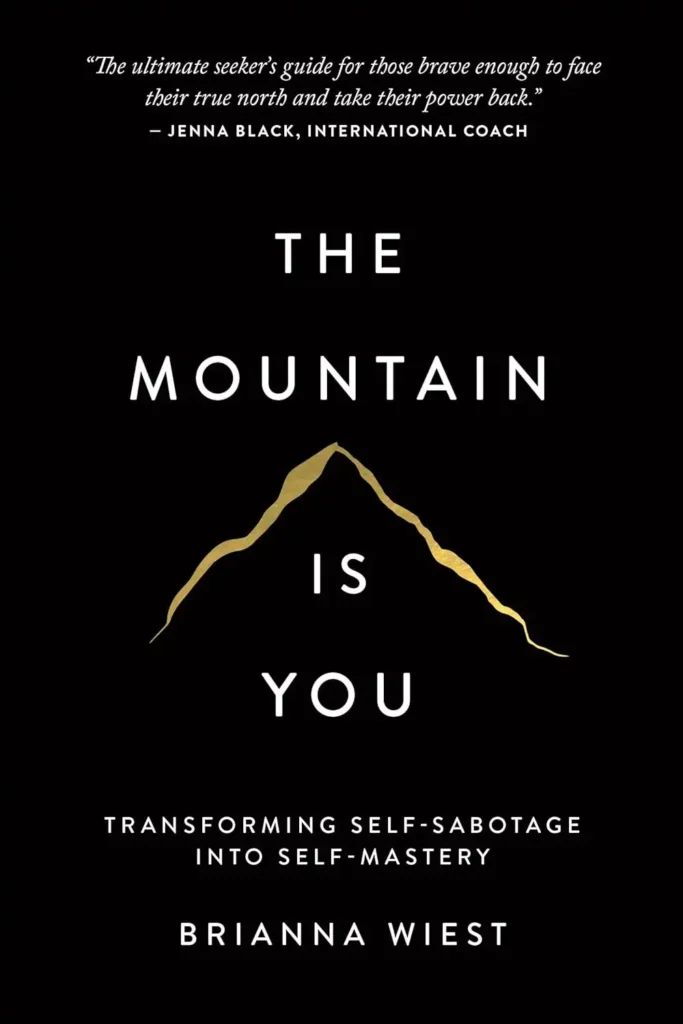
In “The Mountain Is You,” Brianna Wiest offers a radically different approach to fear and anxiety. Instead of treating them as enemies to defeat, she reveals how they’re messengers trying to tell you something important. The path to overcoming fear isn’t through force—it’s through understanding.
Fear Is Information, Not Truth
The first critical shift in overcoming fear is understanding that it’s not telling you what will happen—it’s telling you what you’re focused on. Wiest explains: “Your feelings aren’t predictions. They are not fortune-telling mechanisms. They are only reflecting back to you what your current state of mind is.”
When you feel afraid, you’re not receiving advance warning about the future. You’re experiencing the emotional result of thoughts focused on potential threats. The fear feels prophetic because it’s intense, but intensity isn’t the same as accuracy.
This distinction matters because most people treat fear as credible information about what’s likely to occur. “If I feel this scared, something bad must be about to happen.” But fear is actually revealing where your attention is, not where your future is headed.
Understanding this prevents you from treating every fearful feeling as important wisdom requiring action. Sometimes fear is just your mind’s tendency to scan for threats, not actual threats approaching.
The Difference Between Fear and Instinct
One of Wiest’s most important insights involves distinguishing between fear and genuine instinct. They can feel similar, but they function completely differently.
“Your instincts aren’t actually feelings; they are responses,” she explains. Instinct is the immediate knowing that moves you toward or away from something without deliberation. It’s quiet, certain, and doesn’t require you to convince yourself of anything.
Fear, on the other hand, is loud, argumentative, and creates elaborate scenarios. “Instinct is not a feeling (you don’t have an ‘instinct’ that you’re sad today); instinct is quickly moving yourself out of harm’s way without having to think about it.”
When you’re genuinely in danger, you don’t sit there feeling afraid—you respond. You jump back from the oncoming car. You remove your hand from the hot surface. The action happens faster than thought.
Most of what we call fear is actually anxiety—manufactured scenarios our minds create. Real instinct doesn’t need your mind’s involvement. It just moves you. Learning to distinguish between the two prevents you from treating anxious thoughts as intuitive wisdom.
Why Anxiety Persists
Wiest identifies a key reason anxiety continues despite your efforts to eliminate it: “Chronic fearful thinking often comes back down to feeling the need to focus our energy and attention on a potential threat so we can protect ourselves from it.”
Your anxiety isn’t random. It’s your brain trying to control uncertain outcomes by constantly monitoring for potential problems. You think: “If I worry about it enough, I can prevent it” or “If I imagine every possibility, I’ll be prepared for anything.”
This creates a paradox. The very thinking meant to make you feel safer actually generates more anxiety. You become hypervigilant, scanning for threats, interpreting neutral situations as dangerous. The fear you’re trying to manage through constant vigilance is actually being fed by that vigilance.
“The very act of holding these fearful thoughts within our minds is exactly how the fear is controlling us in the first place,” Wiest notes. The solution isn’t more thinking about the fear—it’s recognizing the thinking itself as the problem.
The Role of Logical Lapses
Much anxiety stems from what Wiest calls “logical lapses”—gaps in your reasoning process where you jump to worst-case conclusions without thinking through what happens next.
“Most of the anxiety you experience in life is the result of inefficient critical-thinking skills,” she explains. You imagine something scary happening, feel the fear that scenario generates, and stop there. You never think through how you would actually respond, how you’d cope, or how the situation would eventually resolve.
This creates the illusion that the feared event would be catastrophic and permanent. In reality, most things we fear are temporary situations we would eventually navigate, but we never get to that part of the thinking process.
Wiest uses the example of not being afraid of flying: “Why aren’t you afraid of it? Because you don’t have a logical lapse there. You can visualize yourself going on an airplane and successfully getting off.” You can imagine the complete arc—boarding, flying, landing, continuing with your life.
When you have a logical lapse, the climax becomes the conclusion. You imagine losing your job and stop there, feeling the full terror of that moment without thinking: “And then I would update my resume, reach out to contacts, apply for new positions, and eventually find something else.”
Filling in these lapses—thinking through the entire scenario instead of stopping at the scariest moment—dramatically reduces anxiety.
The Function of Chronic Worry
Understanding why your mind worries chronically is essential to reducing it. Wiest explains: “Rumination is the birthplace of creativity. They’re controlled by the same part of the brain.”
Your mind that creates worst-case scenarios is the same mind capable of creative problem-solving. The anxiety isn’t malfunction—it’s your creative capacity being directed at potential problems.
The issue is that this creativity gets stuck in a loop. “If we imagine our worst fears, we can prepare for them. If we mull them over again and again, we can feel protected in a way,” Wiest writes. Your brain believes that thorough mental rehearsal of catastrophes will somehow prevent them.
But this doesn’t work. “Worrying excessively is not a malfunction. You are not of lesser character because you can’t ‘just stop’ and ‘enjoy life.’ Worrying is a subconscious defense mechanism.” It’s trying to protect you, but it’s using a method that actually increases your suffering.
The solution isn’t to eliminate worry entirely—it’s to redirect that creative capacity toward actual problem-solving rather than endless scenario-spinning.
What Triggers Really Mean
Wiest reframes triggers from problems to opportunities: “Triggers are not random; they are showing you where you are either most wounded or primed for growth.”
When something triggers intense fear or anxiety, it’s pointing toward an area that needs attention. Maybe it’s revealing an unprocessed trauma. Maybe it’s highlighting a belief system that no longer serves you. Maybe it’s showing you where you’ve been avoiding necessary growth.
The person triggered by any form of criticism likely has wounds around worthiness that need healing. The person triggered by uncertainty probably needs to develop trust and tolerance for the unknown. The person triggered by success might need to examine their beliefs about whether they deserve good things.
Instead of treating triggers as things to avoid, Wiest encourages viewing them as guides: “If we can see these triggers as signals that are trying to help us put our attention toward some part of our lives that needs healing, health, and progress, we can begin to see them as helpful instead of hurtful.”
This transforms your relationship with anxiety. It’s no longer just an enemy to defeat—it’s information about where you need to direct your healing efforts.
The Practice of Exposure
While Wiest doesn’t advocate forcing yourself into terrifying situations, she does emphasize the importance of gradual exposure: “Exposure is the most common treatment for irrational fear. By reintroducing the stressor into your life in a safe way, you are able to reestablish a line of thinking that is healthier and calmer.”
This works because fear grows when avoided and shrinks when faced incrementally. If you’re afraid of social situations, complete isolation intensifies the fear. Small, manageable social interactions begin to show your brain that the feared outcome doesn’t materialize.
The key is that exposure must be gradual and within your control. Forcing yourself into overwhelming situations often backfires, strengthening fear rather than reducing it. But systematic, progressive exposure—done at a pace you can handle—retrains your nervous system’s threat assessment.
Processing Fear Through the Body
Wiest emphasizes that fear isn’t just mental—it’s deeply physical. “Emotions are physical experiences. We flush our bodies of everything, and regularly so. We defecate, we sweat, we cry, we literally shed our entire skin once a month. Feelings are no different; they are experiences that must likewise be released.”
When fear arises and you suppress it, you don’t eliminate it—you store it in your body. This is why chronic anxiety often manifests as physical symptoms: tension headaches, digestive issues, chest tightness, muscle pain.
To release fear, you must allow it to move through your body. This might mean:
- Breathing deeply into the fear rather than away from it
- Allowing yourself to shake or cry when fear surfaces
- Moving your body through exercise or dance
- Identifying where in your body you feel the fear and consciously relaxing that area
“When we are in a state of fearful thinking, it doesn’t matter what we are afraid of; the thought process follows us from problem to problem,” Wiest notes. The pattern is physical, not just mental. Addressing the physical component is essential.
The Paradox of Acceptance
Perhaps the most counterintuitive insight Wiest offers is that fear loses power when you stop fighting it. “The only true way to get over chronic fear is actually to get through it. Instead of trying to battle, resist, and avoid what we cannot control, we can learn to simply shrug and say, and if that happens, it happens.”
This isn’t resignation—it’s radical acceptance. When you stop treating fear as something that must be eliminated before you can move forward, its grip loosens.
“What keeps the fire of fear raging is the idea that if we accept what we are afraid of, we are giving in to the worst potential outcome,” Wiest explains. But acceptance doesn’t mean wanting something bad to happen. It means acknowledging that you can’t control everything and trusting that you could handle it if it did.
The person who accepts that they might fail can actually try. The person who accepts that they might be rejected can actually connect. The person who accepts that bad things might happen can actually live, rather than spending their life trying to preemptively protect against every possibility.
Building Mental Strength
Overcoming fear long-term requires building what Wiest calls mental strength—not the ability to suppress emotion, but the capacity to experience it without being controlled by it.
“Mental strength is not a measure of how happy we seem, how perfect things are, or how unconditionally ‘positive’ we can be, but that we are able to move through day-to-day life and the occasional challenge with enough fluidity and reason that we aren’t stifled or held back by ourselves.”
This strength develops through:
- Allowing yourself to feel fear without immediately acting on it
- Questioning whether your fearful thoughts are accurate
- Taking action despite fear rather than waiting for it to disappear
- Processing fear through your body rather than just your mind
- Recognizing patterns in what triggers you and working to heal those areas
The goal isn’t to become fearless—it’s to develop a different relationship with fear where it informs but doesn’t control you.
When to Seek Professional Help
While Wiest offers powerful tools for working with fear and anxiety, she’s clear that professional support is sometimes necessary. Chronic anxiety that interferes with daily functioning, panic attacks that feel uncontrollable, or anxiety rooted in significant trauma often requires therapeutic intervention.
“If you feel really tangled up in your thoughts, feelings, and fears, talk to someone,” she advises. A mental health professional can help you develop more sophisticated coping mechanisms, process underlying trauma, and potentially address chemical imbalances that contribute to anxiety.
Seeking help isn’t weakness—it’s recognizing that some fears and anxieties require specialized knowledge to address effectively.
The Ultimate Freedom
Wiest’s vision for overcoming fear isn’t about eliminating it entirely—it’s about not letting it determine your choices. “Fear is not going to protect you. Action is. Worrying is not going to protect you. Preparing is.”
The person who has overcome fear isn’t the person who never feels it. It’s the person who feels it and moves forward anyway. Who recognizes fear as information, processes it appropriately, and then makes decisions based on their values and goals rather than their anxieties.
“When we are in full acceptance, fear leaves our consciousness and becomes a non-issue,” Wiest concludes. Not because the feared thing couldn’t happen, but because you’ve accepted that you would handle it if it did.
This acceptance—this willingness to be with your fear rather than at war with it—is what ultimately dissolves its power. You stop feeding it with resistance. You stop strengthening it with avoidance. You acknowledge it, learn from it, and keep moving.
The mountain of fear that seemed insurmountable becomes smaller when you stop running from it and start walking through it. Not because the fear disappears, but because you discover you’re capable of carrying it without being crushed by it.