Learn how to break the worry loop, stop overthinking, and regain control of your thoughts with practical and proven strategies that actually work.
Breaking the Worry Loop Before It Breaks You
The worry loop is one of the most draining mental cycles you can experience. It doesn’t just visit occasionally—it lingers, repeats, and grows stronger the more attention you give it. If you’ve ever laid awake at night replaying the same thoughts, imagining outcomes, or trying to “figure everything out,” then you already understand how powerful this loop can be.
The worry loop is not just thinking. It is repetitive, unresolved thinking that creates emotional tension without producing clarity. It convinces you that if you just think a little longer, analyze a little deeper, or prepare a little more, you will finally reach peace.
But that moment never comes.
In Emotional Hoarding by Laurie Davies , worry is described as something we accumulate. Instead of resolving concerns, we store them. Each worry becomes another layer of mental clutter, filling our minds until there is little space left for clarity or calm.
And here is the truth most people overlook: the worry loop is not solving your problems. It is amplifying them.
Why the Worry Loop Feels Productive
One of the reasons the worry loop is so hard to break is because it feels useful. It gives the illusion of control.
When you worry, it feels like you are preparing. It feels like you are staying ahead of potential problems. It feels responsible.
But in reality, worry is not preparation. It is repetition.
You are not solving new problems—you are revisiting the same ones.
The brain confuses activity with progress. So when your thoughts are constantly moving, it feels like something is happening. But movement is not the same as resolution.
In fact, most worry operates in a closed loop:
- You imagine a problem
- You analyze it
- You feel anxiety
- You try to think your way out
- You return to the same starting point
This cycle creates mental exhaustion without delivering answers.
The Real Cost of Living in a Worry Loop
The impact of the worry loop goes deeper than stress. It affects your entire way of living.
Mentally, it clouds your thinking. You struggle to focus because your attention is constantly pulled toward unresolved concerns. Decision-making becomes difficult because every option feels risky.
Emotionally, it creates a constant sense of unease. Even when nothing is wrong, it feels like something could go wrong at any moment.
Physically, worry triggers stress responses in the body. Increased heart rate, muscle tension, poor sleep, and fatigue are all common results of prolonged worry.
Relationally, it can distance you from others. You may become distracted, irritable, or withdrawn because your mind is always elsewhere.
Over time, the worry loop doesn’t just affect how you think. It affects how you live.
Signs You Are Stuck in the Worry Loop
The worry loop often becomes so normal that you stop noticing it. But there are clear signs if you look closely.
You may be stuck in the worry loop if you:
- Replay the same thoughts over and over
- Struggle to make decisions because you fear the wrong choice
- Constantly imagine worst-case scenarios
- Feel mentally exhausted without doing much
- Have trouble sleeping because your mind won’t stop
- Try to “figure everything out” before taking action
These patterns are not just habits. They are signals that your mind is overloaded with unresolved concerns.
Why Most Worries Never Happen
One of the most eye-opening truths about worry is how inaccurate it is.
Most worries are predictions—not realities.
You imagine what could go wrong, but those scenarios are often based on fear rather than fact. Studies and observations consistently show that the majority of worries never materialize.
And even when they do, they are often less severe than expected.
So why does worry feel so convincing?
Because your brain is wired to detect threats. It prioritizes safety over accuracy. It would rather overestimate danger than underestimate it.
But this survival mechanism, when left unchecked, creates unnecessary suffering.
You end up living through problems that don’t exist.
The Psychology Behind the Worry Loop
To truly break the worry loop, you need to understand how it works.
At its core, worry is driven by uncertainty. The mind dislikes not knowing what will happen, so it tries to fill in the gaps.
It creates scenarios, runs simulations, and searches for answers.
But uncertainty cannot always be resolved through thinking.
So the brain keeps searching.
This creates a loop:
- Uncertainty triggers worry
- Worry seeks certainty
- Certainty is not found
- Worry continues
The key insight here is that the problem is not uncertainty—it is your response to it.
5 Proven Ways to Break the Worry Loop
Breaking the worry loop is not about eliminating worry completely. It is about interrupting the cycle and changing your relationship with your thoughts.
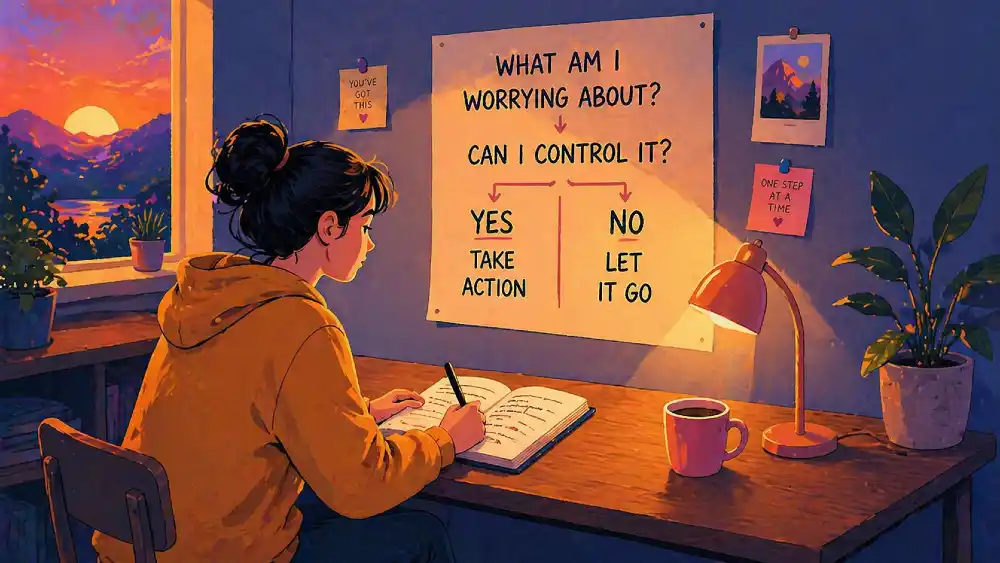
Focus on What You Can Control
Worry thrives on things you cannot control. The future, other people’s actions, unexpected events—these are all outside your control.
Shift your focus to what is within your control:
- Your actions
- Your responses
- Your decisions
This shift immediately reduces the power of worry because it grounds you in reality.
Challenge Distorted Thinking
The worry loop often exaggerates problems. It jumps to worst-case scenarios and treats them as likely outcomes.
Ask yourself:
- Is this actually likely?
- What evidence supports this thought?
- What is a more realistic outcome?
This process helps break the automatic pattern of fear-based thinking.
Limit Overthinking Time
It may sound counterintuitive, but setting boundaries on thinking can be powerful.
Give yourself a specific time to think about a problem. Once that time is up, shift your attention elsewhere.
This prevents worry from taking over your entire day.
Take Action, Even Small Steps
Worry often keeps you stuck in thought. Action breaks that cycle.
Even small steps can create momentum:
- Make a call
- Write a plan
- Start a task
Action replaces uncertainty with progress.
Redirect Your Focus
Your mind can only focus on one thing at a time. When you intentionally shift your attention, you interrupt the worry loop.
Engage in activities that require focus:
- Physical movement
- Creative work
- Meaningful conversations
This gives your mind a break from repetitive thinking.
The Role of Trust in Breaking the Worry Loop
At a deeper level, the worry loop is often about trust.
It reflects a struggle to believe that things will work out, that you will be okay, or that you can handle what comes.
Building trust—whether in yourself, in life, or in a higher purpose—reduces the need for constant mental control.
When trust increases, worry decreases.
Replacing the Worry Loop with Clarity
Breaking the worry loop does not leave a void. It creates space.
Space for clearer thinking.
Space for better decisions.
Space for peace.
Instead of reacting automatically, you begin to respond intentionally.
Instead of being consumed by possibilities, you focus on realities.
Instead of trying to control everything, you learn to navigate uncertainty with confidence.
Living Without the Constant Noise
Imagine what your mind would feel like without the constant background noise of worry.
Quieter.
Clearer.
More focused.
That is what happens when you step out of the worry loop.
Life does not become free of challenges, but your relationship with those challenges changes.
You stop living in anticipation of problems and start living in the present.
And that shift changes everything.
Final Thoughts on the Worry Loop
The worry loop feels powerful, but it is not permanent.
It is a pattern—and patterns can be changed.
You do not need to solve every possible problem before it happens. You do not need to think your way to certainty.
You only need to step out of the loop.
And once you do, you will realize something important.
Peace was never found in worrying more.
It was found in letting go.
FAQs
What is the worry loop
The worry loop is a repetitive cycle of overthinking and unresolved thoughts that creates anxiety without solving problems.
Why is the worry loop hard to break
Because it feels productive and gives the illusion of control over uncertain situations.
Does worrying help solve problems
No, most worry is repetitive thinking that does not lead to solutions.
How can I stop overthinking
By focusing on what you can control, challenging negative thoughts, and taking action.
Are worries usually accurate
Most worries are exaggerated or never happen at all.
Can the worry loop be completely eliminated
Not entirely, but it can be managed and significantly reduced with practice.
Related posts:
 6 Eye-Opening Truths About Fear and Control (And How to Finally Break Free)
 How to Overcome Fear and Anxiety Without Fighting Yourself (The Mountain Is You by Brianna Wiest)
 12 Subtle Ways You’re Sabotaging Your Life And Don’t Even Know It (The Mountain Is You by Brianna Wiest)
 The Mountain Is You Summary: 25 Key Insights from Brianna Wiest