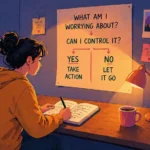
Discover how fear and control are connected, why control increases anxiety, and how to break free from fear-driven habits to live with confidence and peace.
Fear and Control: The Hidden Connection That Shapes Your Life
Fear and control are deeply connected, yet most people don’t realize how strongly one feeds the other. Fear is not always loud or obvious. Sometimes it hides beneath everyday behaviors—planning, organizing, double-checking, or trying to “stay on top of everything.”
On the surface, these actions look responsible. Even admirable.
But underneath, something else may be driving them.
Fear.
In Emotional Hoarding by Laurie Davies , fear is described not just as an emotion, but as something that accumulates. When fear is not addressed, it doesn’t disappear—it builds. And as it builds, it begins to shape behavior.
One of the most common ways it shows up is through control.
Control becomes the strategy we use to manage fear. If we can control the situation, the people around us, or the possible outcomes, then maybe we can avoid pain, uncertainty, or failure.
But this strategy comes at a cost.
Why Fear Naturally Leads to Control
Fear is rooted in vulnerability. At its core, fear is the anticipation of being hurt—emotionally, physically, or psychologically.
When you feel vulnerable, your instinct is to protect yourself.
Control feels like protection.
If you control your environment, you reduce unpredictability.
If you control your schedule, you reduce uncertainty.
If you control people, you reduce the chance of disappointment.
It makes sense.
But there’s a hidden problem.
The more you rely on control to manage fear, the more dependent you become on control itself.
And since life is inherently unpredictable, that control is always under threat.
Which means the fear never really goes away.
The Illusion of Control
Control feels powerful, but in reality, it is fragile.
You can plan your day, but unexpected things will still happen.
You can guide relationships, but you cannot fully control how others think or act.
You can prepare for the future, but you cannot guarantee outcomes.
Control gives the illusion of certainty—but not the reality of it.
And when that illusion is challenged, fear intensifies.
This creates a cycle:
- Fear leads to control
- Control creates temporary relief
- Loss of control increases fear
- Fear leads to more control
Over time, this cycle becomes exhausting.
You are constantly trying to manage things that cannot be fully managed.

Signs You Are Living in Fear and Control
Fear-driven control often hides behind socially acceptable behaviors, which makes it harder to recognize.
But there are patterns that reveal it.
You may be operating from fear and control if you:
- Feel anxious when things don’t go according to plan
- Struggle to delegate tasks or trust others
- Overthink decisions because you want to avoid mistakes
- Try to anticipate every possible outcome
- Feel responsible for how others feel or act
- Become frustrated when situations are unpredictable
These behaviors are not random—they are attempts to reduce uncertainty.
But instead of creating peace, they often create pressure.
How Control Impacts Your Relationships
One of the most significant consequences of fear and control is how it affects relationships.
Control can feel like care, but it often comes across as pressure.
When you try to control outcomes, you may unintentionally:
- Dismiss other people’s perspectives
- Take over responsibilities instead of sharing them
- React strongly when things don’t go your way
- Create tension instead of connection
Over time, this can push people away.
Relationships thrive on trust, flexibility, and understanding. Control restricts all three.
The more you try to control people, the less natural the relationship becomes.
And ironically, the fear of losing connection can lead to behaviors that create that very outcome.
The Emotional Cost of Living in Control
Living in a constant state of control is exhausting.
Mentally, it requires constant vigilance. You are always thinking ahead, planning, adjusting, and anticipating.
Emotionally, it creates tension. You feel responsible not just for yourself, but for everything around you.
Physically, it can lead to burnout. Your body remains in a heightened state of alertness, which drains energy over time.
And internally, it creates a sense of pressure that never fully goes away.
You may appear composed on the outside, but inside, there is a constant effort to keep everything from falling apart.
That is not freedom.
That is survival mode.
Why Letting Go of Control Feels So Uncomfortable
If control is exhausting, why is it so hard to let go?
Because control feels safer than uncertainty.
Letting go of control means accepting that:
- You cannot predict everything
- You cannot prevent every negative outcome
- You cannot guarantee success
That uncertainty feels uncomfortable.
It creates a sense of vulnerability that most people try to avoid.
But here’s the deeper truth:
Avoiding uncertainty does not eliminate it. It only postpones your experience of it.
Letting go of control is not about giving up responsibility. It is about accepting reality.
And reality includes unpredictability.
Understanding the Root of Fear
To break free from control, you need to understand the fear beneath it.
Ask yourself:
- What am I afraid will happen if I don’t control this?
- What outcome am I trying to avoid?
- What does this situation represent to me?
Often, the fear is deeper than the situation itself.
It may be fear of failure.
Fear of rejection.
Fear of losing stability.
Fear of not being enough.
Control is just the surface response. Fear is the root.
And you cannot eliminate control without addressing the fear driving it.
6 Powerful Ways to Break Free from Fear and Control
Breaking free from fear and control does not happen overnight. It requires awareness, practice, and patience.
Recognize Control Patterns
The first step is awareness. Notice when you are trying to control situations unnecessarily.
Ask yourself whether control is truly needed—or whether it is fear-driven.
Accept Uncertainty
Uncertainty is not a flaw in life—it is a fundamental part of it.
The more you accept this, the less you feel the need to control everything.
Shift from Control to Influence
Instead of trying to control outcomes, focus on influencing them.
You can guide, support, and contribute—but you cannot dictate everything.
This shift reduces pressure while still allowing you to take action.
Practice Letting Go in Small Ways
Start with small situations where you intentionally release control.
Let someone else make a decision.
Allow things to unfold without interference.
These small steps build confidence in your ability to handle uncertainty.
Reframe Fear
Instead of seeing fear as something to eliminate, see it as information.
Fear tells you where you feel vulnerable. That awareness can guide growth.
Build Trust
Trust is the opposite of control.
Trust that you can handle challenges.
Trust that not everything needs to be perfect.
Trust that uncertainty does not equal failure.
The more you build trust, the less you rely on control.
Living Without Fear-Driven Control
Imagine making decisions without overanalyzing every possible outcome.
Imagine allowing situations to unfold without feeling the need to manage every detail.
Imagine feeling calm even when things are uncertain.
This is what happens when you loosen the grip of control.
You don’t become careless—you become flexible.
You don’t lose direction—you gain freedom.
You don’t eliminate fear—but you stop letting it control you.
Final Thoughts on Fear and Control
Fear and control are closely connected, but they are not inseparable.
You can experience fear without letting it dictate your actions.
You can face uncertainty without trying to eliminate it.
You can live without constantly trying to manage everything around you.
Control may feel like safety, but it often creates more pressure than peace.
True freedom comes not from controlling everything—but from learning to navigate life without needing to.
And that is where real confidence begins.
FAQs
What is the connection between fear and control
Fear often leads people to seek control as a way to reduce uncertainty and avoid negative outcomes.
Why does control increase anxiety
Because it creates pressure to manage things that are often unpredictable or uncontrollable.
How can I stop being controlling
By recognizing fear-driven behaviors, accepting uncertainty, and practicing letting go.
Is control always a bad thing
No, but excessive control driven by fear can be harmful to mental health and relationships.
Why is letting go of control so hard
Because it requires accepting uncertainty and vulnerability.
Can you overcome fear and control
Yes, with awareness, practice, and building trust in yourself and the process of life.